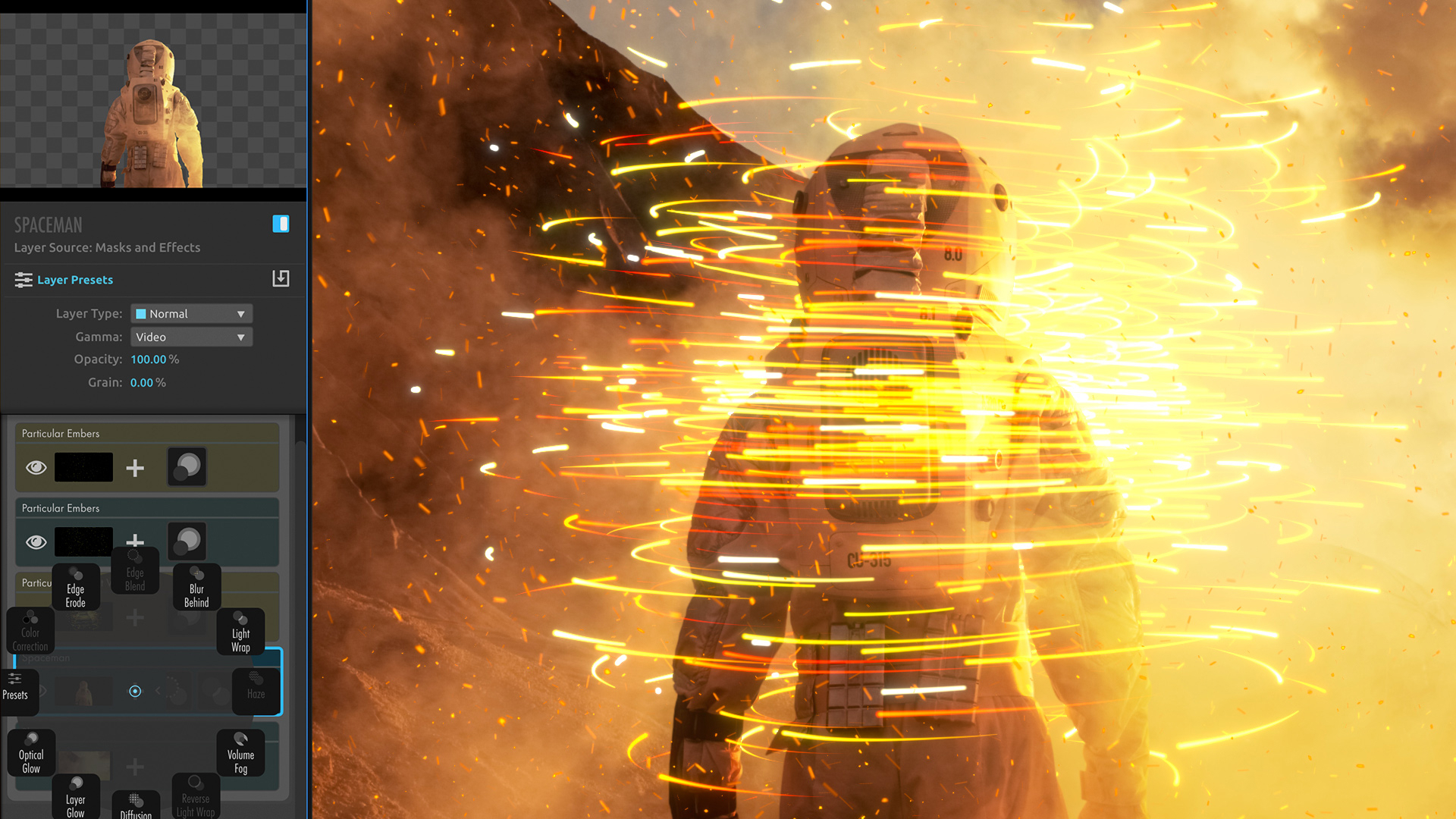
A GPU-accelerated compositing environment for After Effects where light and atmosphere react to every layer. Light wrap, haze, and dispersion update automatically when a background moves or changes, eliminating the need for manual setup with multiple precomps.
What is compositing?
Compositing is the craft of combining separate visual elements (e.g. a keyed actor, a background plate, a 3D render, a logo) into a single, seamless image. The work spans a few core jobs: keying, light wrap, tracking, shadows and reflections, lens matching, and atmosphere effects. Red Giant makes purpose-built tools for each of those jobs, so a green-screen interview or a full set extension comes together inside the host you already run and wows clients in frame-by-frame reviews.
Benefits
Composites that read as one scene

Pull the key in one click, refine the rest
Primatte Keyer’s auto-compute typically nails the key in on its first pass, so you can focus more time on intricate details like wispy hair and motion-blurred edges. If Primatte Keyer can’t key in one click, its refinement tools handle the harder parts in minutes.
Make your light wrap truly shine
Supercomp reads every layer, providing an accurate light wrap that bleeds background brightness around foreground objects. Built natively, it takes a precomp stack that breaks whenever the background changes and updates the wrap automatically when you update elements.


One AI depth pass, many effects
Depth Generator estimates a depth map from a single clip, entirely on your machine using local AI models. The map plugs into effects like Bokeh for a near-to-far rack focus or Trapcode Particular's ZBuffer feature for particles that pass behind your subject. Click 'Render to Comp' to pre-render your depth pass in the background, allowing for enhanced responsiveness and productivity.
Our Users
Built for you
Capabilities
Built for composites that hold up
Convincing composites without the precomp maze
Supercomp brings a context-aware compositing environment to After Effects. It reads every layer at once, so light and atmosphere react to changes instead of waiting on a fully rebuilt precomp stack.
- Light wrap that updates across layers in real time
- Volumetric fog, haze, and glow
- 17 GPU-accelerated compositing tools
- Node engine results without having to actually use nodes
- Swap a background and the comp updates automatically


Clean keys, faster
Primatte Keyer's GPU auto-compute can nearly nail the comp on its first pass. To help you complete the shot, Red Giant offers easy-to-use refinement tools to handle the rest.
- Fast, automatic chroma keying
- Edge refinement and core solidification
- Spill suppression built in
- Keys green, blue, or any other backing color
- Previews and renders up to three times faster than prior versions
- 8-, 16-, and 32-bit color depth support
From raw plate to finished shot
One shot can run the whole toolkit inside After Effects: plate in, finished composite out, with tracking and cleanup handled along the way.
- Key the plate with Primatte Keyer
- Match the lens with Lens Distortion Matcher
- Track with King Pin Tracker, clean up with Spot Clone Tracker
- Set elements in the scene with Reflection and Shadow
- Add ray-traced light with Real Lens Flares, then assemble it all in Supercomp


Where Red Giant's compositing tools run
Red Giant's compositing tools are plugins, and compatibility varies by tool. After Effects is the primary host and runs all ten tools; Bang, Supercomp, Reflection, Shadow, King Pin Tracker, Spot Clone Tracker, Depth Generator, and Lens Distortion Matcher run only there. Reflection and Shadow are not supported on WinARM. The per-tool matrix lives in the Red Giant Compatibility article on the Maxon support site, which stays current.
- After Effects: the complete compositing toolkit
- Autograph: Real Lens Flares and Optical Glow in Maxon's layer-based compositor
- DaVinci Resolve (19/20): Real Lens Flares, Optical Glow
- Premiere Pro (CC 2025/2026): Primatte Keyer, Real Lens Flares, Optical Glow
Our Solutions
All you need for compositing in one go
Red Giant's VFX category is a set of single-purpose compositing tools that includes keying, tracking, cleanup, depth, flares, and final assembly. Each tool does one job, and they all come with a Red Giant subscription. Red Giant also ships inside Maxon One alongside Cinema 4D, Redshift, and ZBrush.
PRODUCT ECOSYSTEM
A chroma keyer with deep manual control that keys any backing color. Auto-compute often pulls a usable key on its first pass, edge refinement and core solidification clean up what's left, and a dedicated spill killer does what its name says. The result is a clean matte in fewer steps.
Simulates light traveling through a real lens, ray traced for a physically based result, so a flare sits in the shot rather than floating over it. Scales from a subtle accent to a full anamorphic look in After Effects, Autograph, DaVinci Resolve, and Premiere Pro.
Photorealistic glow with an optically correct inverse-square falloff that highlights bloom the way real light does. Built-in gamma management handles any footage encoding: video, log, or linear. The look runs from a quiet sweetener to a full lightsaber or neon treatment.
Flattens a lens-distorted plate so you can composite onto the straightened image, then rewarps everything back together. Mark one straight edge and the tool solves the distortion; logos or CG then sit correctly in fisheye or action-cam footage.
Reads scene depth from ordinary footage with AI monocular depth estimation that runs locally, then outputs a grayscale depth map as MP4 or a PNG sequence. The map plugs into effects like Bokeh rack focus and Trapcode Particular's ZBuffer.
Tutorials
Learn compositing on your own schedule
Cineversity hosts Red Giant tutorials across the whole flow, keying through tracking. Three places to start, taught by artists who use the tools daily:
Getting Started with Supercomp
Seth Worley

In Depth with VFX Primatte Keyer
Red Giant

Real Lens Flares: Beginner's Guide (4-part series)
Maximus Raharjo

How our tools are used
Case studies
From our users
Testimonials
How it works
How to get started with Maxon's compositing tools
Compositing with Red Giant happens inside After Effects. Install the tools once, then apply them as effects on your layers. A real shot usually follows one arc: pull the key, place the subject, then light it and marry the layers so they share a scene. The four steps below run that arc on a green screen shot, from raw plate to a cohesive composite.
Pull the clip into Primatte Keyer and let auto-compute take its first pass. Refine the edges and solidify the core, then knock down spill with the built-in refinement tools. Primatte Keyer handles any backing color. A blue or red screen works just as well as green.
Set the keyed subject over the new background plate. If the foreground and background were never lit to match, the subject still reads as a sticker on the plate, or the plate came off a wide or action-cam lens, Lens Distortion Matcher can resolve these discrepancies to create a cohesive scene.
Add Real Lens Flares for ray traced light through a simulated lens, and Optical Glow for blooms with optically correct falloff. These are the cues that sell one light source touching both layers. They also preview fast enough to iterate while the client watches.
Bring the layers into Supercomp, where light wrap, haze, and dispersion react to every element in the comp. Move or swap the background and the wrap updates on its own. The result behaves like a high-end compositing engine while staying on the After Effects timeline.
Frequently Asked Questions
What is compositing in visual effects?
Compositing combines separate elements (keyed footage, 3D renders, atmosphere, effects) into a single cohesive scene that looks like it was photographed in one take. Every step, from keying and light wrap to tracking and lens effects, supports that goal of creating one seamless image. Red Giant's compositing tools cover each of those tasks inside the host you already work in.
Can you do professional compositing without a node-based app?
A multidisciplinary artist can build convincing composites in After Effects with Supercomp, which delivers node-style layer interaction without a separate application to learn. For a freelancer or small studio, that keeps the work inside the host they already cut in.
What is light wrap, and why does it matter?
Light wrap bleeds background light around a foreground subject's edges so a composite reads as one scene instead of a sticker on a plate. Without it, even a clean key looks pasted on. Supercomp updates light wrap automatically as the layers behind it change, so swapping a background doesn't mean rebuilding the wrap by hand.
How do you composite onto lens-distorted footage?
Footage from wide or action-cam lenses bends straight lines, so added elements don't sit right against the plate. Lens Distortion Matcher flattens the plate from one marked edge, lets you composite onto the straightened image, then brings back the original lens warping with everything as one image. Logos and CG match the footage's curve instead of floating over it.
Why isn't green screen keying one click?
Real footage rarely keys in one click. Hair and motion-blurred edges need masking to isolate regions plus detailed refinement work. Primatte Keyer makes keying as fast as it can be, with auto-compute and refinement tools to finish the more complicated aspects of the process.
Why isn't there a standalone light wrap tool?
No standalone effect could do the job properly. A single light wrap effect can only reference one other layer, which falls apart the moment a composite has several layers interacting. Supercomp handles the wrap across multiple layers and updates it in real time as they change.

Bring every element together
into one cohesive shot.
Key it, match it, light it, then marry it in Supercomp, all without leaving After Effects. The whole toolkit comes with Red Giant, and with Maxon One when you're ready for the rest of the pipeline.
14-day free trial. No credit card required. Cancel anytime.