
Naissance d’une sculpture Dans les coulisses de 'The Guardian' d’Ayrton Diaz.
Workflows et résultats
Artiste 3D spécialisé dans les personnages, Ayrton Diaz a ressenti le besoin de créer un projet qui lui permettrait de se démarquer et de tracer (ou plutôt de sculpter !) sa voie vers de nouvelles opportunités. Diaz nous explique comment il a combiné la suite ZBrush et Adobe Substance 3D avec d'autres outils dans son workflow pour donner vie au "Gardien", le personnage détaillé et saisissant qu'il a créé lors de son apprentissage du pipeline de production des jeux vidéo AAA à la Zombie Art School.
Chaque personnage a une histoire, mais les personnages d'exception portent les marques de leur passé sur eux. Le dernier projet d’Ayrton Diaz, « The Guardian », offre un spectacle de détails texturés qui laissent entrevoir un passé caché. En s’appuyant sur la récente offre groupée ZBrush-Adobe Substance 3D, Diaz a créé une œuvre saisissante qui illustre les possibilités créatives illimitées du monde de la sculpture numérique.
Installé à Lima (Pérou), Diaz, 31 ans, a débuté sa carrière comme graphiste et directeur artistique, travaillant sur des campagnes pour de grandes marques telles que Huawei, Mobil et Pavco Wavin.
Il a par la suite opéré une transition vers le statut d'artiste 3D indépendant spécialisé dans les personnages, en se focalisant sur des projets liés aux cinématiques et en participant à la création d'illustrations 3D pour des campagnes publicitaires.

Nous avons discuté avec Diaz de son travail sur « The Guardian » et de la manière dont il s’est concentré sur chaque étape de son workflow pour obtenir des résultats remarquables.
Qu’est-ce qui vous attire dans le design de personnages ?
Diaz : J’aime la science-fiction, la pop culture, le cinéma et les jeux vidéo. Pendant mon enfance, j’ai passé des heures à jouer à des jeux sur ordinateur comme « StarCraft », « Warcraft » et « Age of Empires ». J’ai toujours été fasciné par tout ce qui pouvait être créé sur un ordinateur, et je n’aurais jamais imaginé qu’un jour je travaillerais sur des projets similaires.
Par la suite, je me suis beaucoup intéressé au cinéma, à la photographie et à la direction artistique. J’adore créer des personnages. À travers eux, je peux raconter des histoires et imaginer qu’ils ont une vie et quelque chose à dire. C’est pour cette raison que j’accorde beaucoup d’attention à chaque étape de la production. Chaque détail, texture, matériau, pose et environnement révèle quelque chose. C’est le storytelling qui me pousse réellement à créer des personnages.

D’où vient l’inspiration de « The Guardian » ?
Diaz : L’inspiration est née de mon désir de rejoindre un studio et de m’investir pleinement dans une production d’envergure. La recherche d’opportunités est assez difficile, compte tenu de la conjoncture de ces dernières années. Le fait d'être basé en Amérique latine représente une difficulté supplémentaire en raison de facteurs tels que l'éloignement géographique, le décalage horaire et la diminution globale et progressive des postes en télétravail.
Je me suis persuadé que, pour être compétitif sur le marché, je devais créer quelque chose de véritablement remarquable et ambitieux, capable d’attirer l’attention des artistes, des recruteurs et au-delà. J’ai découvert un concept artist chinois 顾德雄, au portfolio impressionnant, très apprécié par de nombreux artistes 3D. J’ai pris l’un de ses concepts et je lui ai donné vie.
Parlez-nous de votre processus de création de personnages et des outils que vous avez utilisés.
Diaz : Tout d’abord, j’ai rassemblé des références dans PureRef pour structurer le projet. Une fois la vision d’ensemble définie, j’ai commencé la phase de blocking dans ZBrush, en établissant tous les éléments et les formes générales qui définissent la présence du personnage et ce qu’il transmet. J’ai utilisé Marvelous Designer pour simuler tous les vêtements, puis je suis retourné dans ZBrush pour la sculpture finale.
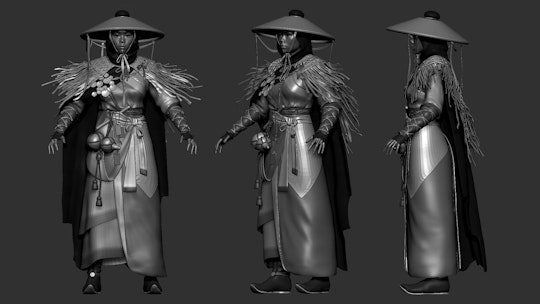


J'ai commencé par les détails perceptibles à mi-distance, puis je suis passé à l'ajout de micro-détails en haute définition, comme les pores de la peau et les rayures. J'ai débuté par la simulation des vêtements, sur lesquels j'ai retravaillé les formes, précisé les plis ainsi que les coutures, pour ensuite ajouter graduellement les micro-détails. J’ai surtout utilisé le Standard Brush, en ajustant l’intensité et la taille pour créer de l’usure et des dégradations. Une fois la tenue du personnage terminée, je suis passé au détail de chaque élément individuellement.
J’ai réalisé le low poly dans Maya, où j’ai créé une retopologie optimisée et prête pour le jeu à l’aide de Quad Draw, puis utilisé RizomUV pour déplier les UVs. L’étape de baking et de texturing dans Substance Painter a été une partie particulièrement plaisante du processus pour moi. J'y ai joué avec les variations de teintes pour apporter du contraste et de la richesse, en utilisant des tons plus marqués afin d'ajouter des éléments narratifs comme des taches, de la poussière, l'effet du soleil et de l'usure.

Enfin, j’ai mis en place l’éclairage, préparé la scène et rendu les images finales dans Unreal Engine.
Tout au long du processus, j’ai constamment navigué entre différents logiciels, ce qui montre à quel point ils fonctionnent ensemble dans mon workflow.
Quels pinceaux ou techniques ZBrush avez-vous utilisés pour créer un niveau de détail aussi saisissant ?
Diaz : Pour certains éléments, comme la cape en paille, je suis passé par plusieurs étapes pour obtenir le bon niveau de détail. J’ai traité les éléments en paille qui retombent sur les épaules comme des hair cards (cheveux optimisés pour le jeu). J’ai sculpté plusieurs variations de paille dans ZBrush, en modifiant les formes et les quantités par petits groupes, puis j’ai placé de simples plans rectangulaires au-dessus pour la projection. J’ai tout importé dans Substance Painter, j’ai effectué un baking sur les détails de la paille sur les plans avec l’opacité activée, puis j’ai affiné les extrémités et les bords de chaque brin pour les rendre plus intéressants visuellement. Enfin, j’ai réimporté ces polygones dans ZBrush avec le personnage, puis je les ai dupliqués autour des épaules. Pour certains éléments, comme la cape en paille, je suis passé par plusieurs étapes pour obtenir le bon niveau de détail. J’ai traité les éléments en paille qui retombent sur les épaules comme des hair cards (cheveux optimisés pour le jeu). J’ai sculpté plusieurs variations de paille dans ZBrush, en modifiant les formes et les quantités par petits groupes, puis j’ai placé de simples plans rectangulaires au-dessus pour la projection. J’ai tout importé dans Substance Painter, j’ai effectué un baking sur les détails de la paille sur les plans avec l’opacité activée, puis j’ai affiné les extrémités et les bords de chaque brin pour les rendre plus intéressants visuellement. Enfin, j’ai réimporté ces polygones dans ZBrush avec le personnage, puis je les ai dupliqués autour des épaules.


Pour le chapeau en paille, j’ai commencé la modélisation dans Maya, mais il était composé de pièces à symétrie radiale qui nécessitaient des ruptures et des imperfections pour paraître plus naturel et usé. J'ai déplacé l'élément dans ZBrush et utilisé les grands pinceaux Move pour casser la symétrie de la silhouette principale, en décalant certaines bandes, en brisant la géométrie et en ajoutant une impression d'usure et d'irrégularité.

Globalement, les détails les plus fins ont été réalisés avec les outils les plus simples. ZBrush propose des pinceaux qui sont un peu comme les ABC de la sculpture numérique : Standard, DamStandard et Move. En dehors du travail sur les alphas et les intensités, vous n’avez pas besoin de plus que ces pinceaux pour commencer à créer des détails impressionnants. Je n’ai pas l’impression qu’il existe des techniques spéciales, mais plutôt une utilisation correcte et intelligente de ce que nous avons déjà.

Avez-vous appris quelque chose de nouveau en travaillant sur ce projet ?
Diaz : Ce projet avait précisément pour objectif d’apprendre les standards de production AAA pour le jeu vidéo à la Zombie Art School, donc j’ai beaucoup appris, aussi bien sur le plan technique que sur le plan artistique.
Tout d’abord, travailler la silhouette du personnage est essentiel. Même si cela semble imperceptible, chaque modification détermine en grande partie l'évolution finale du personnage. Il est primordial d'observer le personnage sous toutes ses coutures pour maintenir une véritable homogénéité.
Une planification rigoureuse aide énormément sur le long terme. De nombreux artistes comme moi ont du mal à savoir quand dire « assez » et passer à l’étape suivante, car nous avons le sentiment que ce n’est pas encore assez bien ou que nous pouvons toujours continuer à améliorer les choses. Diviser les tâches de projet et fixer des échéances aide à lutter contre ces difficultés.
Enfin, chaque étape du processus compte — sculpture, texturing, low poly, éclairage, rendu, etc. Une bonne sculpture ne vaut rien si le texturing est plat, ou si l’éclairage n’est pas assez intéressant pour mettre en valeur le meilleur de votre travail. Si vous ne donnez pas à chaque étape l’importance qu’elle mérite, cela peut rapidement ruiner tout le travail effectué auparavant.
Je suis très reconnaissant envers mon mentor durant ce projet, Ankit Garg, qui m’a guidé jusqu’au bout et m’a aidé à donner le meilleur de moi-même. Le projet n’aurait pas atteint ce niveau sans lui.
Quel a été l’aspect le plus difficile sur lequel vous avez travaillé ?
Diaz : Travailler sur chaque vêtement a été une tâche difficile ; j’ai réalisé de nombreux détails à la main — déchirures, plis, bords effilochés et imperfections. Je connaissais les techniques pour réaliser chaque partie, mais c’était un travail sans fin.
Le low poly du personnage a également été assez éprouvant. Comme il devait être optimisé pour le jeu, j’ai dû planifier avec mon mentor la manière dont j’allais gérer la topologie de toutes ces formes complexes qui interagissaient entre elles.

Enfin, le texturing a été un défi, car il impliquait de nombreuses couches de couleur pour créer du contraste, de la saleté avec différentes intensités et des taches de diverses teintes. Obtenir des textures convaincantes tout en faisant ressortir chaque objet s’est révélé très chronophage.
Combien de temps vous a-t-il fallu pour terminer ce projet du début à la fin ?
Diaz : L’ensemble a pris environ quatre mois et demi. Le high poly est été la partie la plus fastidieuse dans ZBrush. Le détail de tous les vêtements et objets a pris environ un mois et demi.

Quels domaines de la conception de personnage aimeriez-vous explorer à l’avenir ?
Diaz : Quelque chose sur lequel j’aimerais davantage travailler dans mes prochains projets, c’est Substance Designer. J’ai vu de nombreux projets impressionnants en ligne et je veux utiliser ce logiciel pour créer des motifs et des designs uniques pour mes textures. Je suis vraiment impressionné par le niveau de détail qu’il est possible d’atteindre, et c’est quelque chose que j’ai très envie d’apprendre.
Nadia Yangin est rédactrice publicitaire chez Maxon.